
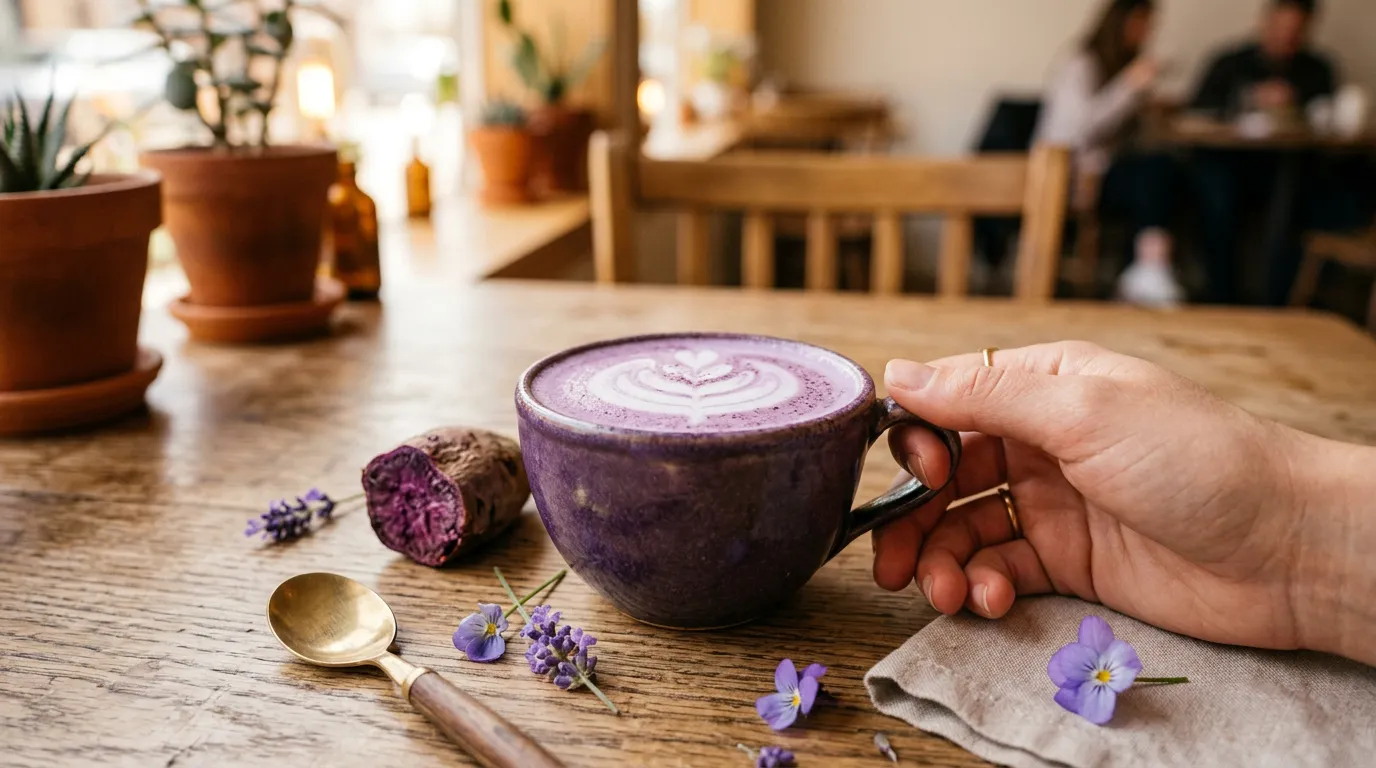
The wellness café scene has seen a lot of colourful drinks come and go, from the matcha green wave of the early 2010s to the golden turmeric latte boom that followed. The latest to capture attention is a deep, vivid purple that looks almost too beautiful to be real: the ube latte, made from ube, the Philippine purple yam that has been a cornerstone of Filipino cuisine and celebration for centuries and that has only recently made its way onto the menus of wellness cafés in Europe, the United States and beyond.
The ube latte is not just a visually striking drink. The vegetable at its centre has a nutritional profile that makes it genuinely interesting from a gut health perspective, and understanding what ube actually contains and how it interacts with the digestive system gives this trend significantly more substance than the typical superfood marketing cycle. For those who want to try authentic ube products to make their own ube lattes at home or explore the full range of ube-based drinks, https://ube-latte-shop.com/ offers a curated selection of ube preparations sourced directly from the Philippines with delivery across Europe.
What ube actually is and why it is different from taro and purple sweet potato
Ube, pronounced oo-beh, is Dioscorea alata, a species of yam native to Southeast Asia and particularly central to Filipino culinary culture. Its most immediate distinguishing characteristic is its colour: a deep violet-purple that runs through the entire flesh of the tuber, not just the skin, and that remains vivid after cooking, blending and heating in ways that make it uniquely suited to visually striking food and drink preparations.
The confusion between ube and two other purple-hued root vegetables, taro and purple sweet potato, is persistent and understandable. All three produce purple or violet coloured preparations and have been used interchangeably in some contexts. Taro, Colocasia esculenta, is a different genus entirely with a more muted greyish-purple colour and a starchier, more neutral flavour profile. Purple sweet potato, Ipomoea batatas, is much closer in appearance to ube but has a distinctly different flavour, sweeter and less complex, and a different nutritional composition.
Ube has a flavour profile that is genuinely difficult to replicate: mildly sweet with vanilla notes, a slight nuttiness and an earthy warmth that is more complex than either taro or purple sweet potato. This flavour complexity is part of what makes it an interesting base for lattes and other drinks rather than a simple colouring agent.
The gut health case for ube
The striking colour of ube is not merely aesthetic. It is produced by anthocyanins, a class of water-soluble pigments from the flavonoid family that give ube, blueberries, red cabbage and other deeply coloured plant foods their characteristic hues. These pigments are also some of the most extensively studied compounds in nutritional science from a microbiome perspective.
Anthocyanins function as prebiotics, providing fermentable substrate that selectively feeds beneficial bacterial populations in the gut. Research published in the Journal of Agricultural and Food Chemistry demonstrated that anthocyanins from purple yam selectively increased Lactobacillus and Bifidobacterium populations in in vitro fermentation models, two genera consistently associated with gut barrier integrity, reduced inflammation and improved digestive function.
Beyond the anthocyanins, ube is a significant source of resistant starch, a form of dietary fibre that bypasses digestion in the small intestine and arrives intact in the colon where it is fermented by the gut microbiota. This fermentation produces short-chain fatty acids including butyrate, the primary energy source for colonocytes, the cells that line the colon wall and maintain its integrity. Adequate butyrate production through fermentation of resistant starch is one of the most important mechanisms by which diet supports gut lining health.
Ube also contains inulin-type fructooligosaccharides, prebiotic fibres that are well established in the clinical literature for their ability to increase Bifidobacterium counts, reduce gut transit time and improve markers of digestive comfort including bloating and constipation.
How to make an ube latte at home
The ube latte is more accessible to prepare at home than its café presentation might suggest. The key is sourcing quality ube powder or ube extract that retains the anthocyanin content and flavour complexity of fresh ube rather than artificial colouring and flavouring agents designed to mimic its appearance.
A basic ube latte requires approximately one teaspoon of ube powder or half a teaspoon of concentrated ube extract, 250 ml of milk or milk alternative, a sweetener of choice and optionally a shot of espresso for those who prefer a caffeinated version. Heat the milk to just below boiling, whisk in the ube powder or extract until fully incorporated, sweeten to taste and froth if desired. The result should be a smooth, deeply purple drink with the characteristic sweet, earthy vanilla notes of authentic ube.
For the best gut health benefits, choosing a milk alternative that adds its own fermentable fibre, oat milk for beta-glucan content or coconut milk for medium chain triglycerides, creates a drink whose benefits extend beyond the ube itself. Pairing the ube latte with a probiotic supplement in the morning allows the prebiotic fibres from the ube to feed the beneficial bacteria introduced by the probiotic, a combination that mimics the principles of synbiotic nutrition.
Ube and the Filipino wellness tradition
The enthusiasm of the global wellness community for ube is a relatively recent phenomenon, but in the Philippines the yam has occupied a central place in cuisine and culture for centuries. Ube halaya, a dense jam made from boiled and mashed ube with coconut milk and sugar, is a traditional dessert that appears at Filipino celebrations and family gatherings as a marker of festivity and abundance. Ube ice cream, ube cake and ube cheese bread are fixtures of Filipino bakery culture that have become familiar to Filipino diaspora communities across the world long before ube reached the menus of London and New York wellness cafés.
The global popularisation of ube through social media, driven primarily by its extraordinary visual impact on platforms where food aesthetics are central, has introduced millions of people to a root vegetable that Filipino communities have been celebrating for generations. The wellness interpretation of ube, focused on its prebiotic and antioxidant properties, adds a new dimension to a cultural relationship with this vegetable that was always about pleasure and identity as much as nutrition.




[…] ube latte, explored in our detailed guide on ube latte and gut health, is one of the most anthocyanin-rich beverages available, making it a practical and delicious […]
[…] phenomenon, to the more recent ube latte whose prebiotic properties we explored in our guide to ube latte and gut health, these drinks occupy a growing space between beverage and […]